Tutorial 6: Footprints in the Sand
Background
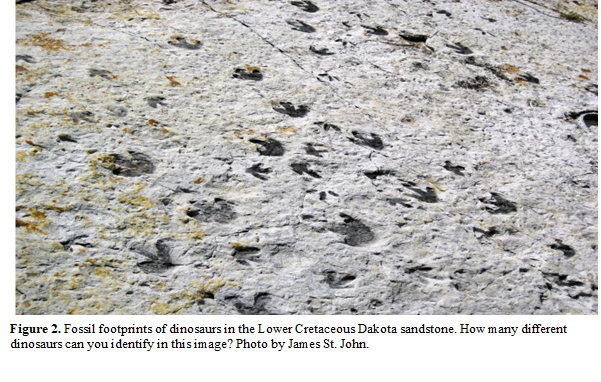
Trace fossils are remnants, or signs, of the activities of the animal that made them (Figure 1). One kind of trace fossil is the existence of footprints. Footprints are hard to preserve, but because any one animal can make thousands and thousands of footprints, it makes preservation of even some of them more likely (Figure 2).
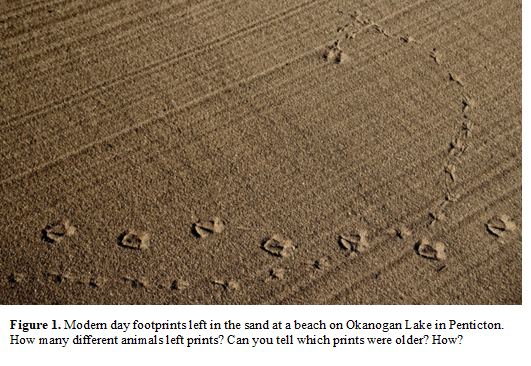
Footprints are can also help paleontologists to understand how big the animal was making the prints and trackways, whether they were bipedal (walked on two feet) or quadrupedal (walked on four feet), how big they were, whether they were walking or running, where they spent time, whether the animals moved together in large herds or alone, whether they took care of their young, feeding behaviors, etc.
Your task In this activity you will “go into the field” and identify the different footprints that have been left by dinosaurs in the past. You will document the pattern of the footprints relative to each other, identify each set as belonging to a particular dinosaur, measure the size of the different footprints, and calculate the height, stride length, and whether the dinosaur was walking or running. Finally, you will construct the history of the site based on the relationships of the footprints to each other.
Procedure
- The first thing you want to do is to survey the entire location and record how many different tracks you can identify, using the Dinosaur Track Identification Chart (Figure 3) on the next page.
- Measure the foot length (Figure 4) of one of each of the different kinds of footprints. Record the information in the data table supplied.
- Measure length of stride length (Figure 4) of each track way and record in data table 1.
- Calculate the following characteristics of the maker of each respective footprint:
- Height at the hips = Foot length X 4
- Dinosaur length = Foot length X 10
- The ration between hip height and stride length = stride length (SL)/hip height (HH)
- Determine whether the dinosaur was walking, trotting, or running when it made the tracks you analyzed.
- If SL/HH is less than 2.0, the dinosaur was walking.
- If SL/HH is 2.0–2.9, the dinosaur was trotting.
- If SL/HH is greater than 2.9, the dinosaur was running.
- Sketch the scene of the footprint area. Keep in mind the order of events (i.e., which footprints are older than others?)
- Create a story of the science where the footprints were created. Evaluate the reliability of your story. What are its strengths and limitations?
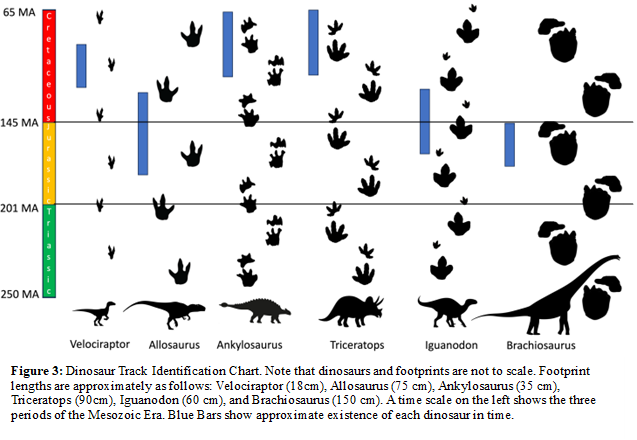
Table 1 Identification and length of each kind of dinosaur footprint
[Insert Table Image]
Tell your story about this site, below:
Sketch the site with its fossils and any notes you think important, below:
Tell the “story” of this place to the best of your ability and imagination, knowing that you MUST be grounded in the data.
References
This activity was designed after the following activities:
American Museum of Natural History. (2007). Activity: Be a trackway detective. New York, NY. https://www.amnh.org/learn-teach/curriculum-collections/dinosaurs-activities-and-lesson-plans/be-a-trackway-detective
American Museum of Natural History. (2007). Activity: Relative speed of dinosaurs. New York, NY. https://www.amnh.org/learn-teach/curriculum-collections/dinosaurs-activities-and-lesson-plans/relative-speed-of-dinosaurs
Beneski Museum of Natural History (no date). Dinosaur footprints: Tracks and traces. Amherst College, MA. https://www.amherst.edu/system/files/Dinosaur%2520Footprints%253B%2520Tracks%2520%2526%2520Traces.pdf